
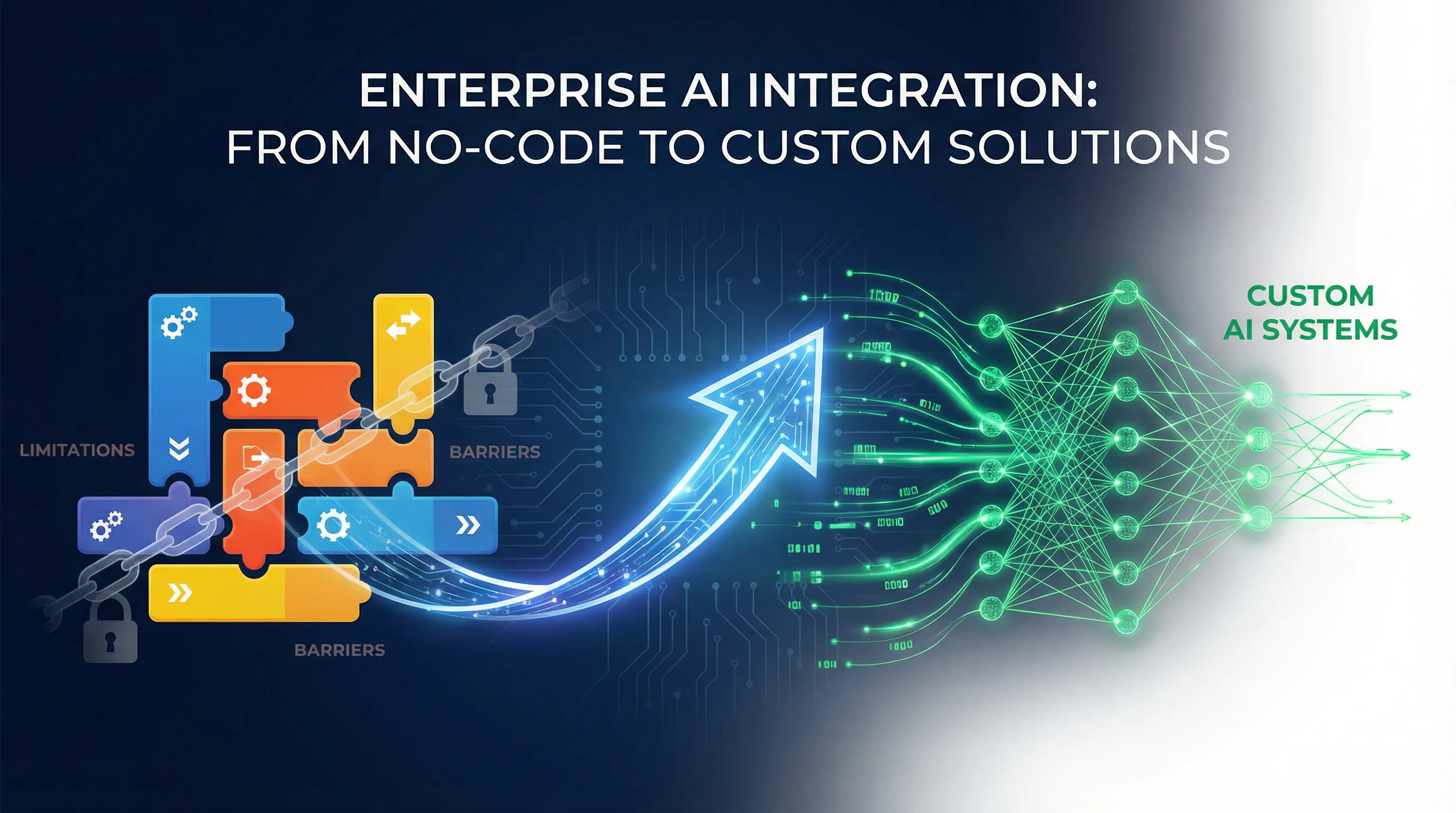
The initial promise of no-code AI was revolutionary: democratized access to machine learning, rapid prototyping, and the ability for non-technical teams to build intelligent applications. For many businesses, these platforms served as a powerful entry point into the world of artificial intelligence. However, as we move further into 2026, a growing number of organizations are discovering that the very simplicity that made no-code so appealing is now becoming their biggest bottleneck. The agentic AI market is projected to surge from $8.5 billion in 2026 to $45 billion by 2030, a clear indicator that businesses are moving beyond simple AI tools and toward sophisticated, integrated systems. When scalability, security, and deep customization are no longer just desirable but essential, the limitations of no-code AI become starkly apparent. This is the point where custom AI integration becomes a strategic imperative.
This in-depth guide is for technology leaders, product managers, and enterprise architects who are confronting the scaling challenges of no-code AI. We will explore the critical reasons why your business may be outgrowing its current tools and provide a comprehensive framework for transitioning to a custom AI development strategy. We will also examine the latest advancements in enterprise AI, including the rise of context-aware copilots, domain-specific Large Language Models (LLMs), and the stringent governance required for production-grade systems.
The No-Code Wall: 7 Signs Your Business Has Outgrown Its AI Platform
No-code AI platforms excel at rapid application development and are invaluable for validating ideas. However, they are often built on a one-size-fits-all model that can hinder growth as business needs become more complex. If you are experiencing any of the following challenges, it is a strong indication that you have hit the no-code wall.
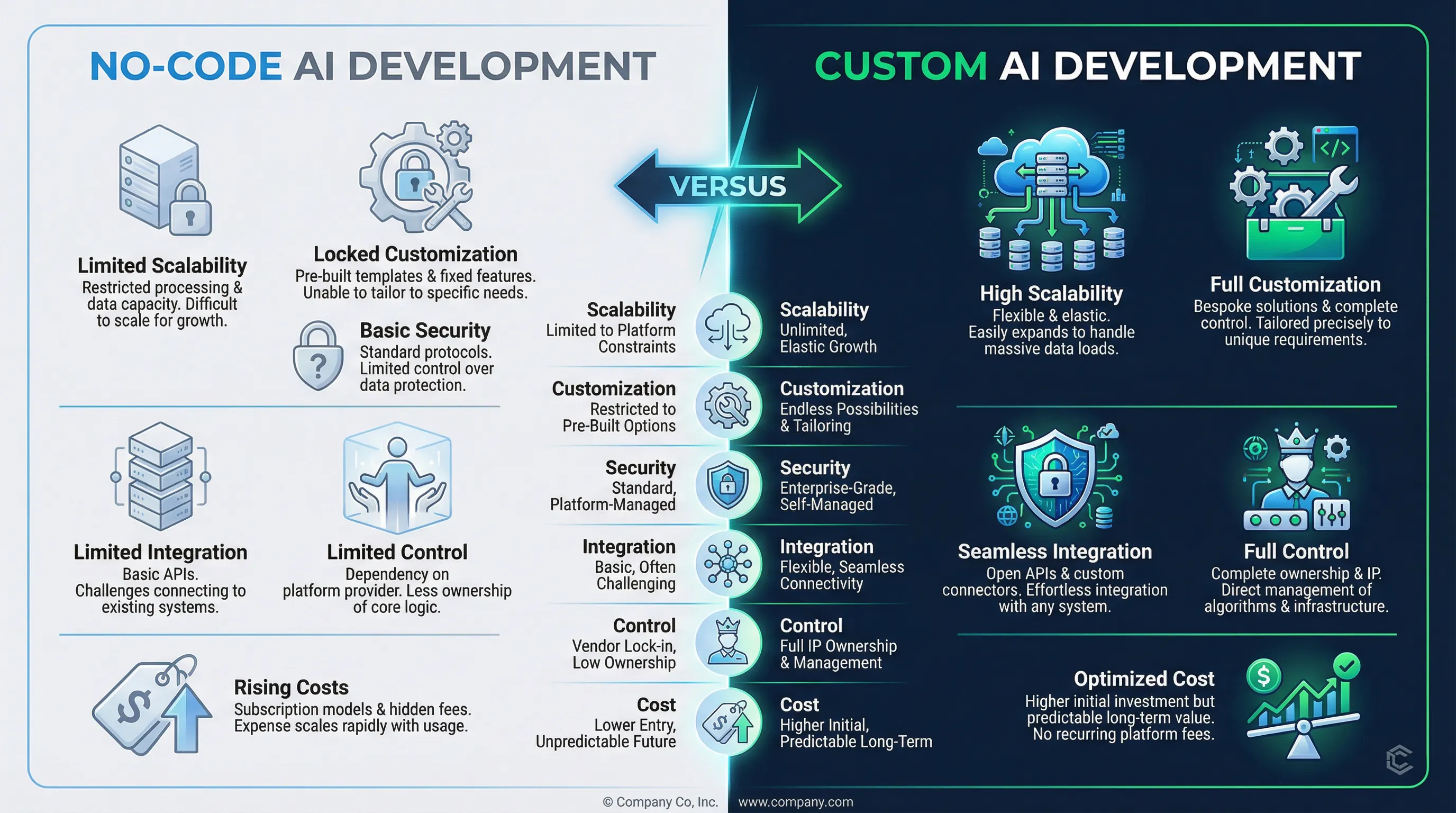
| Limitation Category | No-Code AI Platform | Custom AI Development |
|---|---|---|
| Scalability & Performance | Limited by platform architecture, potential for performance bottlenecks with high user loads or data volumes. | Architected for specific performance needs, enabling horizontal and vertical scaling as required. |
| Customization & Flexibility | Restricted to pre-built components and workflows, making it difficult to implement unique business logic. | Complete freedom to design and implement bespoke features, workflows, and user experiences. |
| Data Governance & Security | Reliant on the platform's security measures, which may not meet stringent enterprise or industry-specific compliance standards. | Full control over data storage, processing, and security protocols, enabling adherence to GDPR, HIPAA, and other regulations. |
| Integration Capabilities | Limited to a predefined set of third-party integrations, often requiring workarounds for unsupported systems. | Seamless integration with any existing enterprise system, database, or third-party API. |
| Model Control & Transparency | Often a "black box" with limited ability to fine-tune models or understand their decision-making processes. | Full transparency into model architecture, training data, and decisioning, with the ability to fine-tune and optimize for specific tasks. |
| Cost at Scale | Can become prohibitively expensive as user numbers, data volumes, or API calls increase. | More predictable and manageable long-term costs, with the ability to optimize infrastructure for efficiency. |
| Intellectual Property | Your data and models may be locked into the platform, making it difficult to migrate or leverage your IP elsewhere. | Full ownership of your code, models, and intellectual property, providing a long-term competitive advantage. |
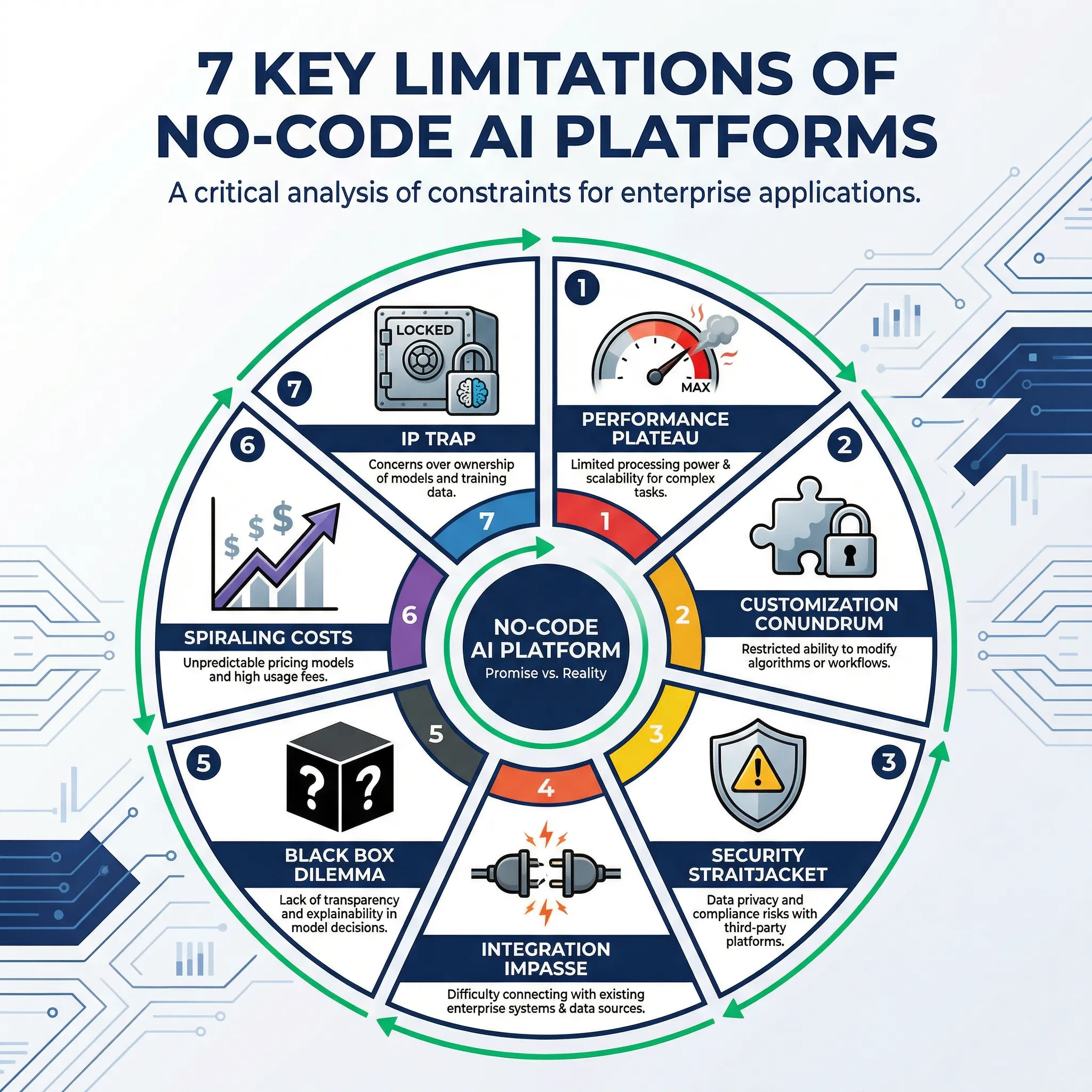
1. The Performance Plateau
Your application is experiencing slowdowns, and you are hitting the limits of your no-code platform's infrastructure. As your user base and data volumes grow, the generalized architecture of no-code platforms can struggle to keep up, leading to a poor user experience and potential downtime. According to Microsoft's 2026 AI trends report, modern AI infrastructure is moving toward "flexible, global AI systems" that "pack computing power more densely across distributed networks." No-code platforms, by their nature, cannot provide this level of architectural optimization.
2. The Customization Conundrum
You need to implement a unique feature or workflow that is not supported by the platform's pre-built components. This is a common challenge for businesses with specialized operational needs or those looking to create a differentiated customer experience. In 2026, the most successful AI implementations are those that are deeply integrated into existing workflows, not bolted on as generic tools.
3. The Security Straitjacket
Your legal and compliance teams are raising concerns about data governance and security. No-code platforms, while often secure, may not provide the granular control required to meet the stringent compliance standards of industries like finance and healthcare. A 2026 report by Lumenalta emphasizes that for enterprise LLM applications, "governance, data quality, and integration maturity are now essential pillars for scaling LLMs securely and cost-effectively." The report further notes that "security and legal teams expect controls that match core systems, not side projects that bypass review."
4. The Integration Impasse
You are struggling to connect your AI application with a critical enterprise system that is not supported by the platform's native integrations. This can lead to data silos and inefficient, manual workflows. Custom AI development allows for seamless integration with any system, including legacy applications, proprietary databases, and third-party APIs.
5. The "Black Box" Dilemma
You have limited visibility into how your AI models are making decisions, making it difficult to troubleshoot errors, mitigate bias, or explain outcomes to stakeholders. This lack of transparency is a significant barrier to building trust in AI systems. As Microsoft's report states, "Trust is the currency of innovation." Custom AI development provides full transparency into model architecture, training data, and decision-making processes.
6. The Spiraling Costs of Success
Your no-code subscription fees are escalating as your usage grows. While initially cost-effective, the pricing models of many no-code platforms can become a significant financial burden at scale. A common pattern is that platforms charge based on API calls, data storage, or user seats, which can quickly become unpredictable and expensive as your business grows.
7. The Intellectual Property Trap
You realize that your most valuable assets—your data and your models—are locked into a proprietary ecosystem, making it difficult to migrate to another platform or leverage your intellectual property in other ways. This vendor lock-in can limit your strategic options and reduce your long-term competitiveness.
The Custom AI Advantage: Building for the Future of Your Enterprise
Transitioning to custom AI development is not just about overcoming the limitations of no-code; it is about building a strategic asset that will drive long-term growth and innovation. Here are the key benefits of a custom approach:
Unparalleled Scalability and Performance
With custom development, you can design an architecture that is specifically tailored to your performance requirements. This includes the ability to scale your application horizontally and vertically, ensuring a seamless experience for your users even as your business grows. Modern custom AI architectures leverage cloud-native technologies, containerization, and microservices to achieve the kind of scalability that no-code platforms simply cannot match.
Limitless Customization and Flexibility
Custom AI development gives you the freedom to build exactly what you need. Whether it is a bespoke workflow, a unique user interface, or a complex integration, you are not constrained by the limitations of a pre-built platform. This is particularly important in 2026, where the most successful AI implementations are those that are deeply tailored to specific business processes and user needs.
Enterprise-Grade Security and Governance
In the age of GDPR and HIPAA, data security and governance are non-negotiable. Custom development provides you with full control over your data, allowing you to implement the robust security measures and audit trails required to meet your compliance obligations. As Microsoft's 2026 AI trends report states, "Every agent should have similar security protections as humans." This includes giving each AI agent a clear identity, limiting what information and systems it can access, and protecting it from attackers and threats.
Seamless Integration with Your Existing Stack
Custom AI applications can be seamlessly integrated with your existing enterprise systems, including your CRM, ERP, and other critical business applications. This eliminates data silos and enables the creation of truly automated, end-to-end workflows. The Lumenalta report emphasizes that in 2026, "IT roadmaps will reflect shared services for prompt routing, vector search, feedback stores, and cost observability across business units."
Enterprise AI Use Cases: Real-World Applications of Custom Integration
To understand the practical benefits of custom AI integration, let us examine some real-world use cases across different industries:
Financial Services: Fraud Detection and Risk Assessment
A major financial institution was using a no-code AI platform for basic fraud detection. However, as transaction volumes grew and fraud patterns became more sophisticated, the platform's limitations became apparent. The institution transitioned to a custom AI solution that integrated with their existing transaction processing systems, customer databases, and third-party risk intelligence feeds. The custom solution provided real-time fraud detection with 99.7% accuracy, reduced false positives by 40%, and enabled the institution to meet stringent regulatory requirements for explainability and audit trails.
Healthcare: Clinical Decision Support Systems
A healthcare provider was using a no-code AI tool for basic symptom checking. However, they needed a more sophisticated clinical decision support system that could integrate with their electronic health records (EHR), lab systems, and imaging databases. They developed a custom AI solution that leveraged domain-specific LLMs fine-tuned on medical literature and their own clinical data. The system provided physicians with evidence-based treatment recommendations, flagged potential drug interactions, and improved diagnostic accuracy by 25%. The custom solution also met HIPAA compliance requirements and provided full audit trails for all AI-generated recommendations.
E-Commerce: Personalized Recommendation Engines
An e-commerce company was using a no-code AI platform for basic product recommendations. However, they needed a more sophisticated system that could integrate with their inventory management, customer relationship management (CRM), and marketing automation platforms. They developed a custom AI solution that leveraged collaborative filtering, content-based filtering, and deep learning to provide highly personalized product recommendations. The custom solution increased average order value by 35%, improved customer retention by 20%, and enabled the company to implement sophisticated A/B testing and optimization strategies.
Manufacturing: Predictive Maintenance
A manufacturing company was using a no-code AI platform for basic equipment monitoring. However, they needed a more sophisticated predictive maintenance system that could integrate with their industrial IoT sensors, maintenance management systems, and supply chain platforms. They developed a custom AI solution that leveraged time series analysis and machine learning to predict equipment failures with 95% accuracy. The custom solution reduced unplanned downtime by 50%, lowered maintenance costs by 30%, and enabled the company to optimize their spare parts inventory.
The Migration Framework: A Phased Approach to Custom AI Integration
Transitioning from a no-code platform to a custom AI solution is a significant undertaking, but it can be managed effectively with a phased approach. Here is a four-phase framework to guide your migration:
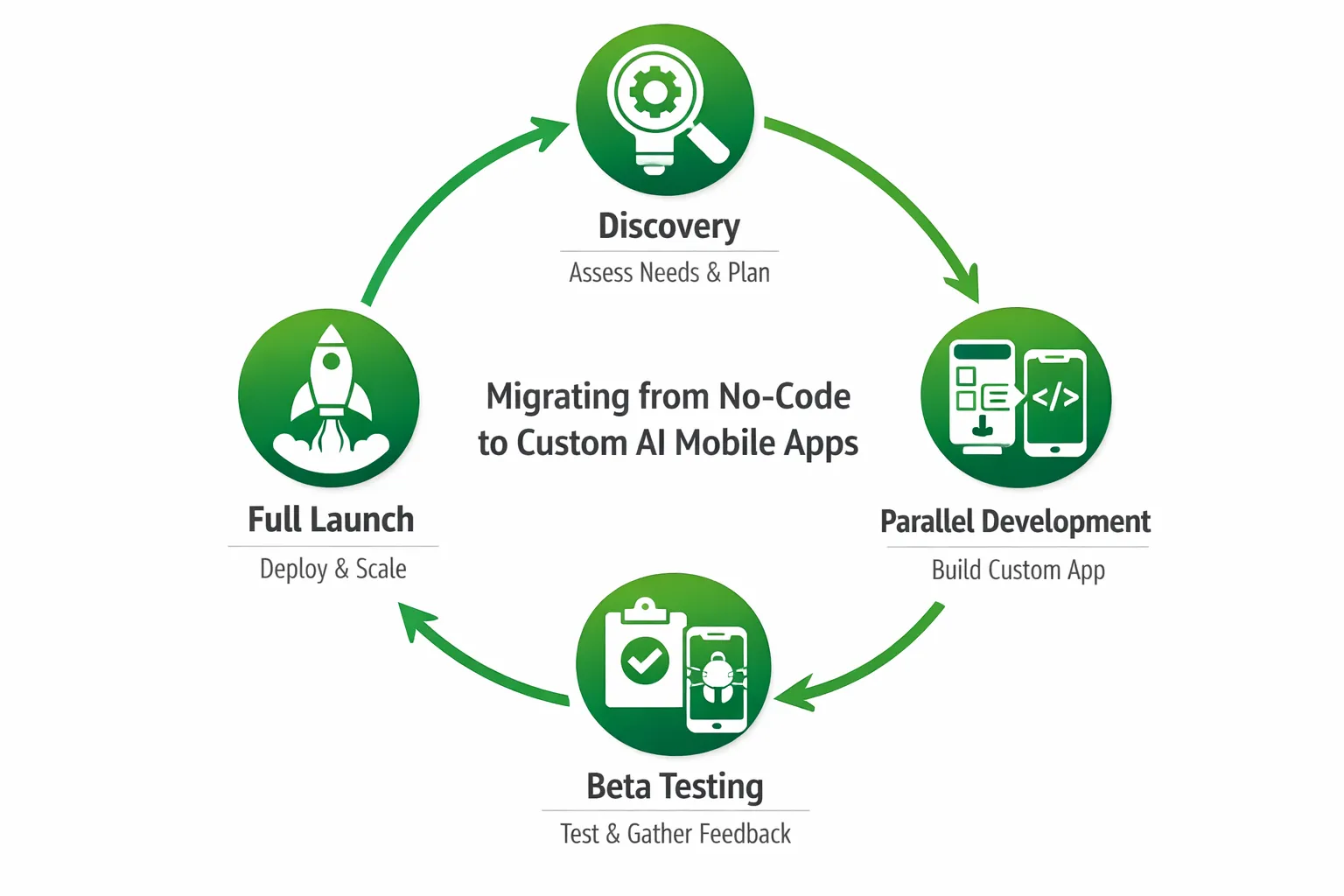
Phase 1: Discovery and Strategy (Weeks 1-3)
The first phase is all about understanding your current state and defining your future vision. This includes conducting a thorough audit of your existing no-code application, identifying its strengths, weaknesses, and the specific pain points that are driving the need for a custom solution. You should document all integrations, data flows, and user workflows. Develop a clear vision for your custom AI application, including its key features, performance requirements, and integration points. Create detailed user stories and use cases. Build a detailed business case for the migration, including a cost-benefit analysis, a projected ROI, and a clear articulation of the strategic benefits. Finally, choose the right programming languages, frameworks, and cloud infrastructure for your custom application.
Phase 2: Design and Architecture (Weeks 4-6)
The second phase focuses on designing the technical architecture of your custom AI solution. Create a detailed architectural plan that addresses your scalability, security, and integration requirements. This should include diagrams of your system components, data flows, and API endpoints. Outline a clear plan for migrating your data from the no-code platform to your new custom database, including data mapping, transformation rules, and validation procedures. Determine which AI models and algorithms are best suited for your use case, and develop a comprehensive security plan that addresses data encryption, access control, authentication, authorization, and audit logging.
Phase 3: Development and Implementation (Weeks 7-14)
The third phase is where you build your custom AI application. Use an agile development methodology to build your application in a series of iterative sprints. Focus on building the most critical features first, and then iterate and expand from there using a minimum viable product (MVP) approach. Implement a comprehensive testing strategy to ensure the quality, reliability, and security of your application, including unit testing, integration testing, performance testing, and security testing. Set up a CI/CD pipeline to automate the build, test, and deployment process.
Phase 4: Deployment and Optimization (Weeks 15-18)
The fourth phase is where you deploy your custom AI application and begin optimizing it for performance and cost. Deploy your new application in a phased manner, starting with a small group of users and then gradually expanding to your entire user base. Continuously monitor the performance of your application and make ongoing optimizations to improve its speed, reliability, and cost-effectiveness. Once your new custom application is fully deployed and stable, you can decommission your old no-code solution. Finally, implement a continuous learning framework to ensure that your AI models remain accurate and effective over time.
The Future is Custom: Embracing the Next Wave of Enterprise AI
The shift from no-code to custom AI is not just a technological upgrade; it is a strategic evolution. As AI becomes more deeply embedded in the core processes of your business, the need for scalable, secure, and customizable solutions will only intensify. By embracing custom AI development, you are not just solving the problems of today; you are building the foundation for the innovations of tomorrow.
The trends for 2026 and beyond are clear: AI is moving from standalone tools to deeply integrated systems that act as digital coworkers. Context-aware copilots are embedding themselves into existing workflows, multi-agent orchestration is automating complex tasks, and domain-specific LLMs are providing unprecedented levels of precision and accuracy. These advancements are only possible with custom AI development.
Ready to move beyond the limitations of no-code? WorksDelight specializes in building custom, enterprise-grade AI solutions that are tailored to your unique business needs. Contact us today to schedule a consultation and learn how we can help you unlock the full potential of artificial intelligence.
Key Takeaways
- The agentic AI market is growing from $8.5B in 2026 to $45B by 2030, signaling a shift toward sophisticated custom solutions
- Seven critical signs indicate when enterprises have outgrown no-code AI platforms
- Custom AI development provides unparalleled scalability, security, and integration capabilities
- Real-world use cases demonstrate 25-50% improvements in key business metrics
- A proven 4-phase migration framework enables smooth transition from no-code to custom AI