
You built something incredible with Bubble. What started as a simple idea became a functional application, and for a while, it worked perfectly. But now, something has changed. Your app is slower, your users are frustrated, and you are spending more time fighting the platform than building features. You are not alone. This is the moment thousands of founders face: the crossroads between staying with no-code and making the leap to custom development.
This guide is not about bashing Bubble. It is a powerful tool that has helped countless entrepreneurs validate ideas and launch products. But every tool has its limits, and understanding when you have reached those limits is critical for your business. This comprehensive analysis will help you make an informed decision about whether it is time to switch from Bubble to custom development.
The 7 Critical Signs You Have Outgrown Bubble
Before diving into technical limitations, let us examine the real-world symptoms that indicate your application has outgrown Bubble. These signs often appear gradually, but recognizing them early can save you significant time and money.
Sign 1: Performance Degradation Under Load
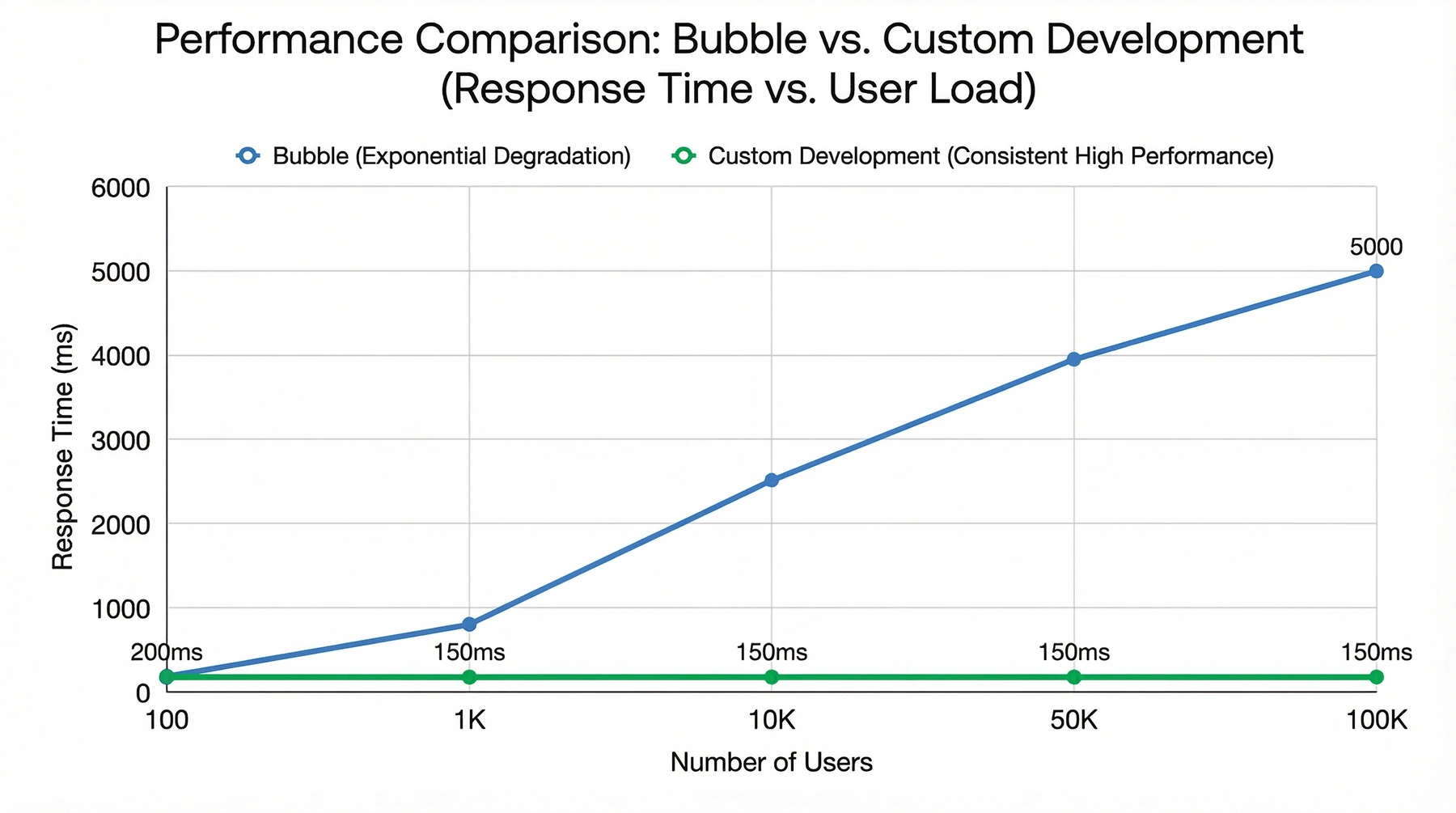
Your application worked flawlessly with 50 users. But now, with 500 concurrent users, page loads take 5-8 seconds, workflows timeout, and users complain about the experience. This is not a configuration issue; it is a fundamental architectural limitation. Bubble's shared infrastructure was not designed for high-concurrency applications.
Sign 2: Database Queries Hitting Hard Limits
Bubble imposes strict limits on database operations. When your searches return incomplete results or your workflows fail silently, you have hit these walls. No amount of optimization within Bubble can overcome these architectural constraints.
Sign 3: Monthly Costs Exceeding Custom Development ROI
At $529 per month for the Team plan (or higher for enterprise features), your annual Bubble costs can quickly exceed what custom development would cost. When you factor in the limitations you are working around, the economics often favor a one-time investment in custom code.
Sign 4: Integration Limitations Blocking Business Growth
Your business needs to integrate with enterprise systems, process real-time data streams, or implement complex authentication flows. Bubble's plugin ecosystem and API connector have limitations that are blocking critical business functionality.
Sign 5: Security and Compliance Requirements
Healthcare (HIPAA), finance (SOC 2), or enterprise clients require security certifications and audit trails that Bubble cannot provide. Your growth is being limited by compliance requirements that no-code platforms cannot meet.
Sign 6: Development Speed Has Plateaued
Ironically, the platform that once made you fast is now slowing you down. Simple features take days instead of hours because you are constantly working around platform limitations. Your developers spend more time on workarounds than actual development.
Sign 7: You Need Features Bubble Cannot Support
Real-time collaboration, complex algorithms, machine learning integration, or custom data processing. These features require capabilities that no-code platforms simply cannot provide, regardless of how creative your workarounds are.
Official Bubble Hard Limits: The Technical Reality
Understanding Bubble's official limitations is crucial for making an informed decision. These are not bugs or temporary issues; they are architectural constraints built into the platform.
Bubble Hard Limits Comparison
| Limitation | Bubble Limit | Custom Development |
|---|---|---|
| Search Results | 10,000 items maximum | Unlimited with proper indexing |
| API Workflow Runs | Plan-dependent limits | Limited only by infrastructure |
| File Upload Size | 50MB per file | Configurable, typically 5GB+ |
| Scheduled Workflows | Limited frequency | Sub-second precision possible |
| Database Relationships | Basic relational support | Full SQL/NoSQL capabilities |
| Custom Code | Limited JavaScript plugins | Any language, any framework |
The True Cost Comparison: Bubble vs Custom Development
Let us break down the real costs over a 3-year period for a growing application:
3-Year Total Cost of Ownership
| Cost Category | Bubble (3 Years) | Custom Development |
|---|---|---|
| Platform/Hosting | $19,044 - $64,800 | $3,600 - $10,800 |
| Initial Development | $0 (already built) | $30,000 - $80,000 |
| Ongoing Maintenance | $15,000 - $30,000 | $12,000 - $24,000 |
| Workaround Development | $20,000 - $50,000 | $0 |
| 3-Year Total | $54,044 - $144,800 | $45,600 - $114,800 |
The numbers tell a clear story: for applications that have outgrown Bubble, custom development often provides better long-term value, especially when you factor in the elimination of platform limitations.
The 8-Week Migration Roadmap
Transitioning from Bubble to custom development does not have to be disruptive. Here is a proven 8-week migration framework:
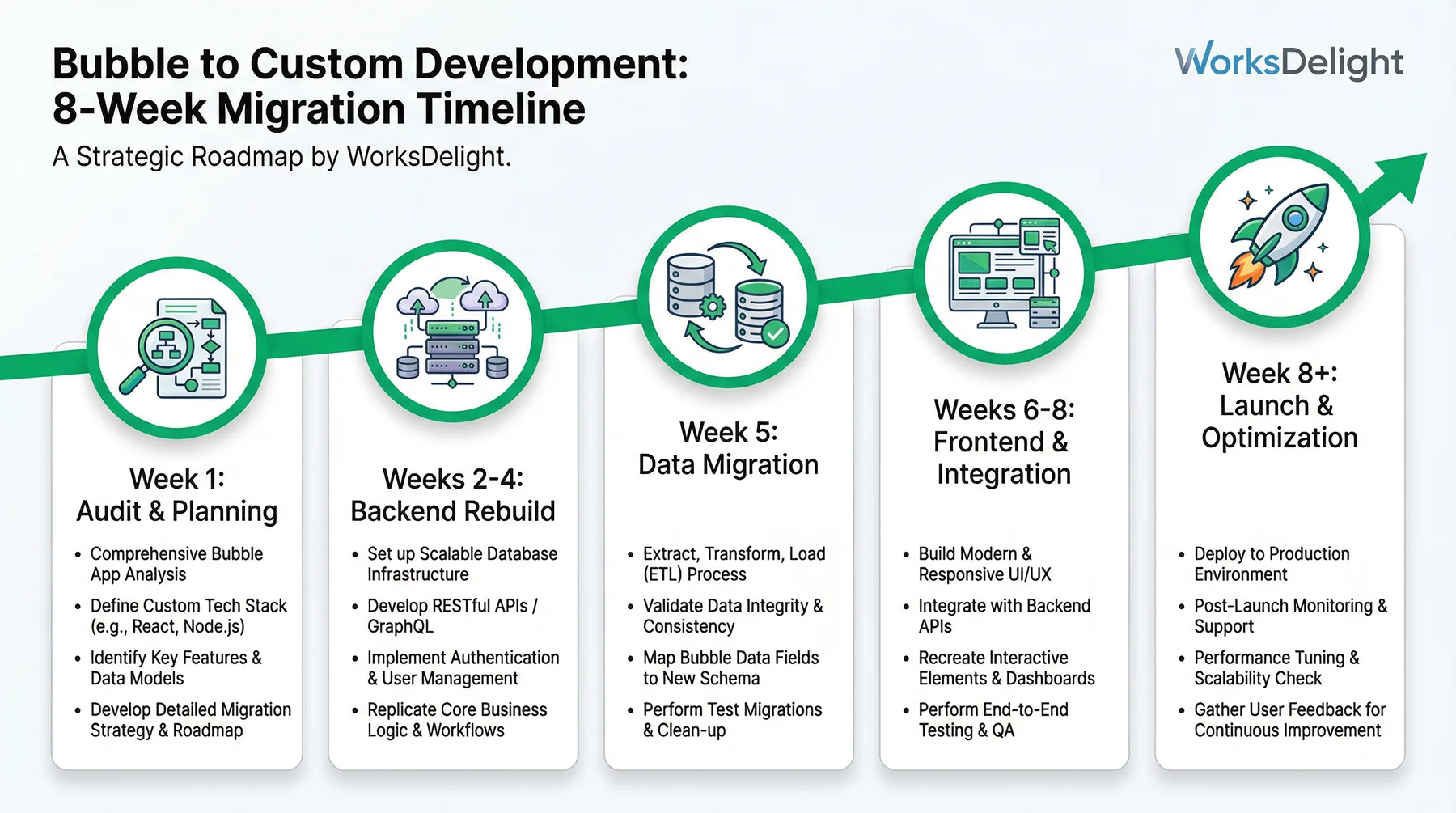
Weeks 1-2: Discovery and Planning
- Complete audit of existing Bubble application
- Document all workflows, data structures, and integrations
- Identify critical features and prioritize migration order
- Select technology stack based on requirements
Weeks 3-4: Core Infrastructure
- Set up development environment and CI/CD pipeline
- Design and implement database schema
- Build authentication and authorization system
- Create API architecture
Weeks 5-6: Feature Migration
- Migrate core business logic
- Rebuild user interface with modern frameworks
- Implement integrations with external services
- Data migration from Bubble database
Weeks 7-8: Testing and Launch
- Comprehensive testing (unit, integration, end-to-end)
- Performance optimization and load testing
- Security audit and penetration testing
- Staged rollout and monitoring
When Bubble Is Still the Right Choice
To be fair, Bubble remains an excellent choice for many scenarios:
- Early-stage validation: Testing market fit before significant investment
- Internal tools: Applications with limited users and simple requirements
- MVPs: Proving concepts before committing to custom development
- Non-technical founders: Building without developer resources
- Simple CRUD applications: Basic data management without complex logic
The key is recognizing when your application has evolved beyond these use cases.
Your Path Forward
The decision to migrate from Bubble to custom development is significant, but it does not have to be overwhelming. The key is making an informed decision based on your specific situation, growth trajectory, and business requirements.
Ready to evaluate your options? At WorksDelight, we specialize in helping businesses transition from no-code platforms to scalable custom solutions. Our team has successfully migrated dozens of Bubble applications, and we understand both the technical challenges and business considerations involved.
If you are experiencing the signs described in this guide, contact us today for a free migration assessment. We will analyze your current Bubble application and provide a detailed roadmap for your transition to custom development.